Deck Resurfacing & Redecking in Greensboro, NC:New walking surfaces on suitable framing

Greensboro Deck Builders helps homeowners compare deck resurfacing and redecking in Greensboro, North Carolina.

Tell us about your deck

Required fields. No appointment booked.

In this context, the project replaces the walking surface on a frame found suitable for reuse. It is a different scope from staining, concrete coatings or a complete structural rebuild. The frame must be assessed before new boards are selected. Posts, foundations, beams, joists, the house connection and stairs can all affect reuse. The proposal should identify necessary repairs and any changes needed for the chosen surface system.

Wood-to-composite conversion can reduce the routine of refinishing the boards, but installation is not always a direct exchange. Support spacing, fasteners, stair construction and fascia may need changes. Those details belong in the scope before the new surface is priced.

Redecking can also be a useful time to compare railings or an under-deck rain system. Coordinate access and installation order. If the frame is broadly deteriorated, a full rebuild may be the more useful project to evaluate. Include the current board material, deck age if known, approximate size and visible condition in your inquiry. Describe the rails and stairs you want retained or replaced so a surface-renewal proposal can account for the surrounding components.

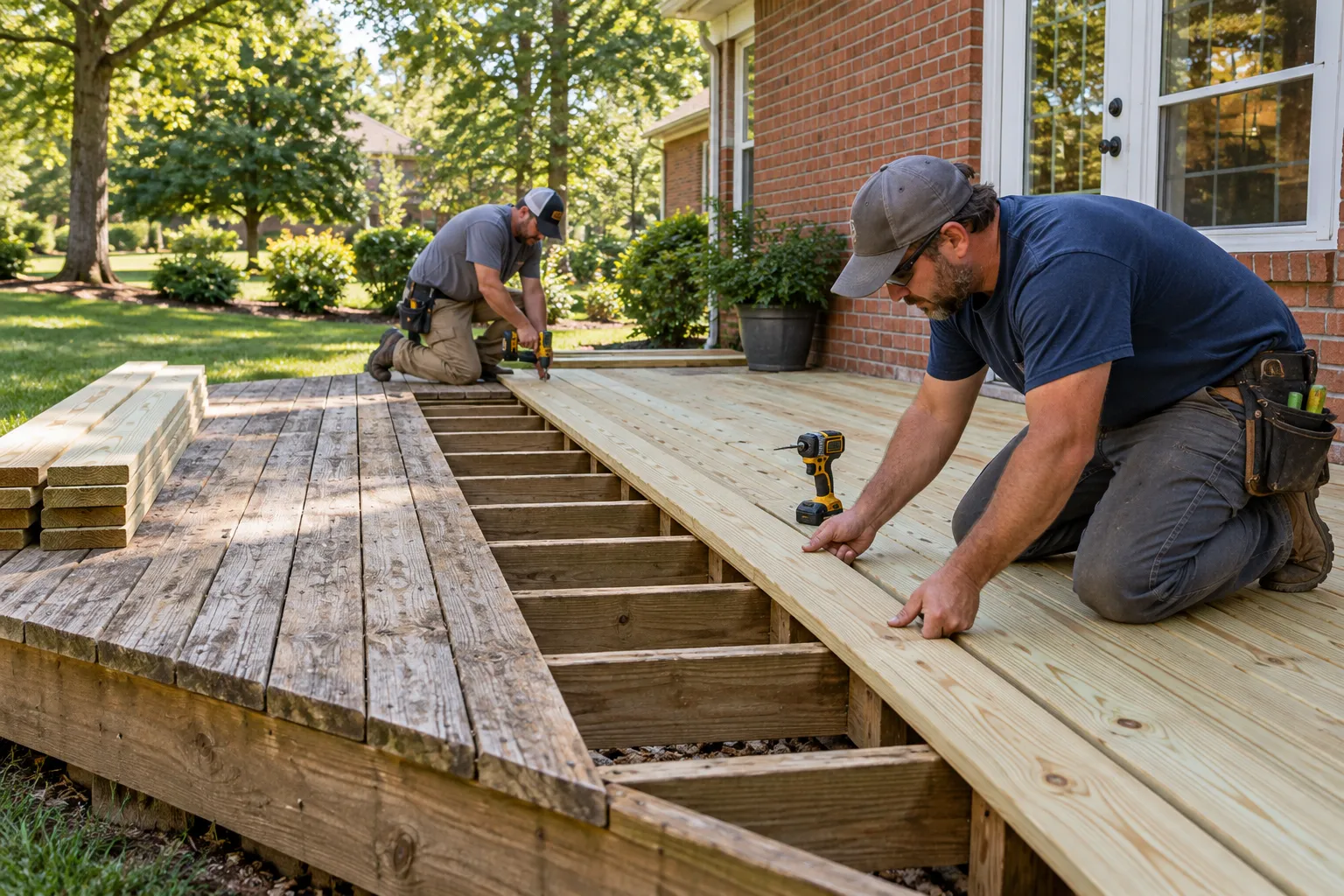
Illustrative installers aligning new boards over a deck frame

Replace the boards while retaining structural components assessed as suitable for reuse.

Deck Resurfacing & Redecking services

Define the work around the condition and use of your space.

Frame assessment before board removal

Existing conditions need evaluation beyond the visible surface. Access to hidden areas may change the final repair scope. The proposal should explain what is known, what will be checked after removal and how additional deterioration will be handled. Retained rails, stairs and the house connection deserve review alongside the joists. Agree on how findings after removal are communicated and approved, so a surface renewal does not proceed while the extent of necessary structural work remains unclear.

A new wood walking surface

Replacing old boards with wood still requires suitable supports, compatible fastening and a finish plan. Discuss board dimensions, gaps and the condition of retained rails and stairs. A new walking surface does not renew structural components that remain beneath it. Include board-edge treatments, stair treads and transitions at the home in the material discussion. The proposal should state how retained components will meet the new boards and which exposed areas are included in any subsequent finish work.

Composite or PVC conversions

Choose the product before finalizing support changes. Joist spacing, stair support, fastening and ventilation should match current manufacturer instructions. Include fascia and cut-end details. The comparison should cover required frame corrections alongside the board installation. Check board orientation and decorative borders against the actual frame. Where the design requires additional support, include it explicitly. The finished surface specification should identify the board collection, accessories and retained structural elements instead of relying on a brand name alone.

Rails, stairs and drainage coordination

Retained components should suit the new surface and overall project. New rail systems may need different attachment details. Above-joist drainage systems can require the boards to be removed, making timing important. Define which parts are replaced, retained or added. Compare the work sequence with the selected rain system and new railing connections before boards are installed. Include stair-surface changes and fascia where needed, so a resurfacing estimate describes the complete usable deck instead of only its central platform.

The details matter

Reuse needs a clear written basis

The appeal of redecking is retaining suitable structure. That decision should be supported by an assessment and an explicit list of retained components. A board-only quote should not be presented as a complete replacement of the deck.

If reuse is not suitable, compare complete deck replacement before committing to a new surface.

Explore the material guide

Deck Resurfacing & Redecking process

A clear scope connects the first assessment to the finished deck.

Assess the retained structure

Review supports, connections and hidden components before choosing redecking.

Select the surface system

Match boards, fastening and stair requirements to the proposed frame.

Set corrections and sequencing

Include necessary repairs, access and any drainage or railing work.

Finish and document the work

Review the new surface and keep care guidance for both new and retained components.

What a complete proposal should cover

Deck Resurfacing & Redecking FAQs

Clear answers before the project takes shape.

Is resurfacing the same as staining?

No. This page uses resurfacing or redecking to mean replacing boards on suitable framing. Staining and sealing renew the finish on existing suitable wood.

How do I know whether my frame can be reused?

It needs a condition and design assessment. The frame must be sound and compatible with the new surface, including supports, fastening and stairs.

Can new composite boards go on old joists?

Possibly, if the joists and overall structure are suitable. Changes in support spacing or other details may be required by the selected product.

Can drainage be installed while the boards are off?

That can be useful timing for systems requiring board removal. The chosen product, clearance and water routing still need to suit the deck and property.

What could your deck become?

Start with your property. Define the work you need.